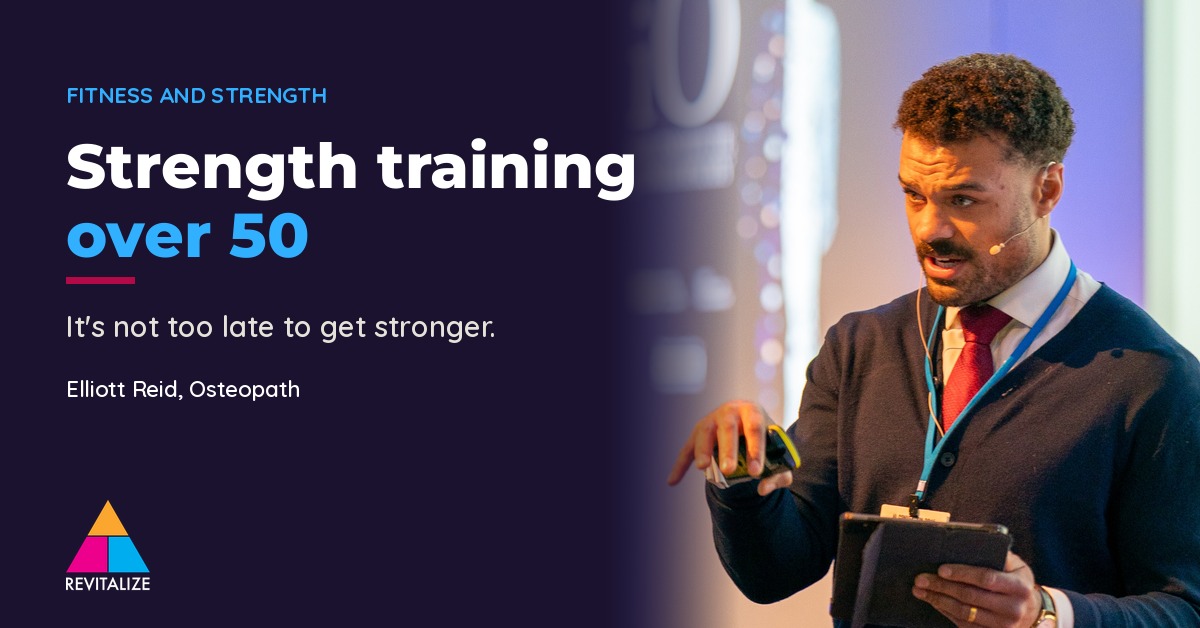
Strength training over 50: it’s not too late to get stronger
By Elliott Reid, Osteopath and Founder, Revitalize Clinic, Gravesend
Most people over 50 who come to see us haven’t exercised properly for a long time. That’s not because they don’t care. It’s because for the last 20 or 30 years, everyone else came first.
You’ve raised children, built a career and paid down the mortgage. You’ve kept the family, the finances and the friendships afloat. But somewhere along the way, something got left behind.
Now you feel stiff. Weaker than you used to be. Perhaps low in mood. And you’ve started to wonder whether you’ll be able to live the retirement you’ve been working towards.
For many people, this is also the age when friends start to become seriously ill. A heart attack, a stroke, a cancer diagnosis. It makes you think about your own health, and ask a bigger question: after giving so much to everyone else, what do you want from the rest of your life?
Is it too late to get fit after 50?
No. The research is clear that your body is still very adaptable at this age, often more than people expect.
Your metabolism hasn’t given up on you
A common belief is that metabolism slows down in midlife. A large international study measuring how much energy people burn each day, in people aged from 8 days to 95 years, found that metabolism (adjusted for body size) stays stable from about age 20 to 60, and only starts to decline after that (Pontzer et al., 2021).
So if your weight has crept up in your fifties, the usual reasons are less movement and less muscle, both of which you can change.
Your biological age can be younger than your birth certificate
Your chronological age is how many birthdays you’ve had. Your biological age is how old your cells behave. One way to measure it is the length of telomeres, the protective caps on the ends of your chromosomes, which shorten as we age.
In a study of nearly 6,000 adults, people with high levels of physical activity had telomeres that suggested around nine years less biological ageing than sedentary adults (Tucker, 2017). This was an observational study, so it shows a strong link rather than proof of cause and effect. But it’s a compelling one.
You can still build bone and muscle
Strength training doesn’t just build muscle. In the LIFTMOR trial, postmenopausal women with low bone density, average age 65, did supervised high-intensity strength and impact training twice a week. After eight months, their spine and hip bone density improved, while the comparison group’s declined (Watson et al., 2018).
The same applies to the muscles and connective tissue around arthritic joints. These are the support systems that take load off the joint itself.
Your brain keeps adapting too
Exercise supports memory, coordination and mood. In the SMART trial, older adults with mild memory problems who did six months of resistance training improved their overall cognitive function (Fiatarone Singh et al., 2014).
Can strength training help you avoid a knee replacement?
Early in my career, I met a woman whose doctor had told her she needed a knee replacement. She wanted to avoid surgery if she could.
A knee replacement deals with the joint itself. If you’re trying to avoid one, you have to work around the joint instead. With her, that meant three things:
- Movement and mobility. Regular movement helps keep the joint’s lubricating fluid moving, and treatment and mobility exercises help to restore range of movement.
- Strength around the joint. Building up the thigh and hip muscles and the surrounding connective tissue so the knee is better supported.
- The rest of her health. The body doesn’t work in isolation. The same exercises that strengthen your thighs, like squats, sit-to-stands and leg lifts, also help your muscles use glucose from your blood.
Alongside dietary advice, her blood sugar became more stable, her weight came down and her knee pain eased. Working with her GP, she was able to reduce her medication for blood pressure and diabetes. And she never had the knee replacement.
She isn’t the only one. We’ve seen many people since who have avoided or delayed hip and knee replacements because they got fitter and the support around those joints improved.
This matches the research. In a Danish trial, people with knee osteoarthritis who were eligible for a knee replacement were given a 12-week programme of exercise, education, dietary advice, insoles and pain medication, delivered by physiotherapists and dietitians. After a year, 74% of them had not gone on to have surgery (Skou et al., 2015). Surgery did give greater pain relief overall, so it isn’t a case of one being right for everyone. But it shows that for many people, a structured, non-surgical approach is a real option.
The same is true of the spine. At the Spinal Unit at Queen’s Medical Centre in Nottingham, a national referral centre for complex spinal problems, osteopaths worked as part of the NHS team for 14 years. They combined hands-on treatment, rehabilitation exercise and education about pain for people with long-term, complex back pain. Health Education England reports that 83.2% of these patients said the care had helped or helped a lot, 96.2% were satisfied with it, and having osteopaths in the team reduced the need for surgery (Health Education England).
The wider health benefits are well documented too. Resistance training reduces HbA1c, a long-term measure of blood sugar, in adults with type 2 diabetes, and the stronger people get, the bigger the improvement (Jansson et al., 2022). It also lowers blood pressure (Cornelissen and Smart, 2013).
What changes in everyday life?
The real benefit isn’t what happens in the treatment room or the gym. It’s what happens in the rest of your life.
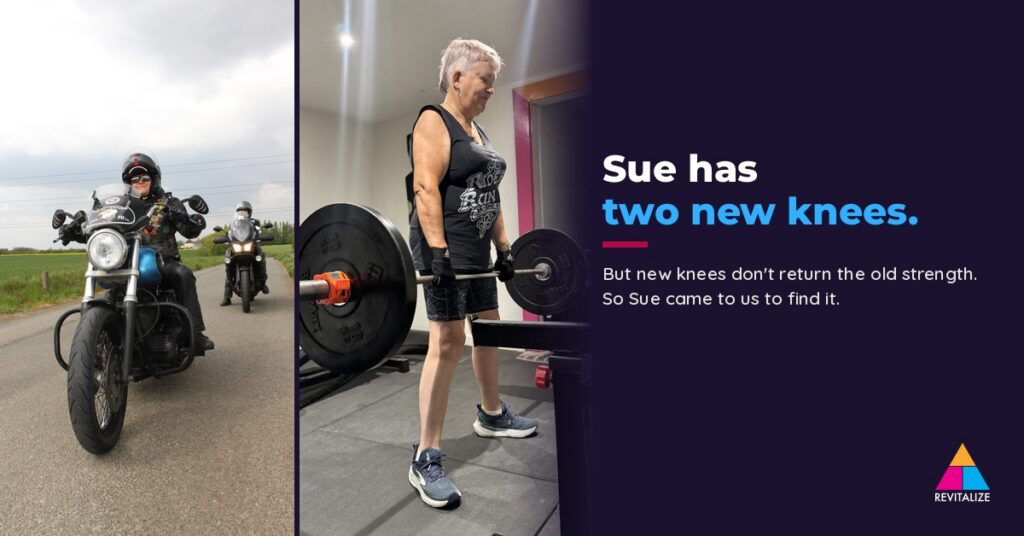
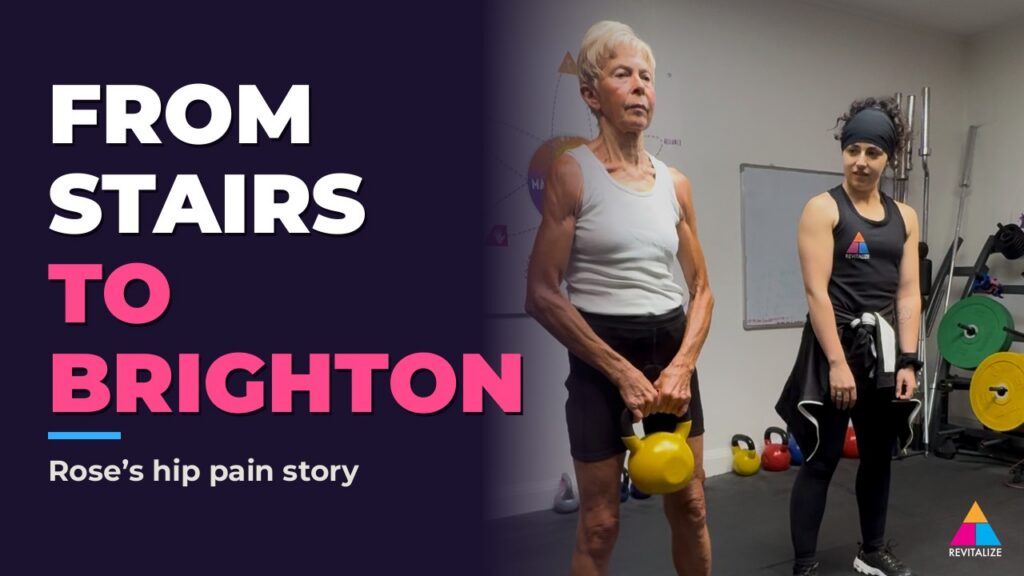
Rumana has kept dancing, and is performing better than before. David and Sue are both still riding their motorbikes, on trips around the country and across Europe. Rose has just ridden her 26th London to Brighton.
None of them came to us to get good at exercise. They came so their health would stop getting in the way of the things that matter to them.
How do we decide where to start?
This is my clinical opinion, based on years of working with people over 50.
Start with what matters to you
Many people come to us without really knowing what they want. They just know they want to be healthier. So the first thing I do is help them find what matters most.
One question I often ask is: “What would you like people to say about you at your retirement party?” Or, looking further ahead: “When all is said and done, what would you like to be able to say when you look back on your life?”
These questions give people clarity. From that point of view, you no longer worry about what others think, or the things you regret, or the small stuff that fills most days. You can focus on what a good life looks like for you. Once we have that answer, we can plan.
Look at your resources
Next we look at what you have to work with: your time, your budget for treatment or training, your current skills and your activity history.
If you’ve never exercised, that’s absolutely fine. We start from scratch. If you used to lift weights, box or play football, we build on those skills, because familiar movements are often easier to return to.
Find what’s getting in the way
Then we look at the barriers. It might be knowing what to eat, finding the discipline to keep going, a difficult relationship with food or exercise, or a fear of movement after pain or injury.
Because our team includes people who specialise in pain, injury, diet, exercise and psychology, we can work on each barrier together rather than leaving you to deal with them alone.
When do we refer you elsewhere?
Sometimes we need to bring in other medical professionals. That might be when we’ve genuinely tried our best and things aren’t improving, or when you’ve already tried everything before coming to us.
After assessing the joint, we might suggest that a steroid injection is worth discussing, or that you could be a good candidate for a joint replacement. In those cases we refer you back to your GP or orthopaedic consultant.
But the decision is always yours. Some people decide an injection or surgery doesn’t fit with what they want for their lives, and they carry on with their training and still do very well. Others go ahead, and we help them prepare and recover. Either way, the plan is built around you.
How to start strength training over 50: first steps
- Pick one reason. Write down the thing you want to keep doing, or get back to. It will carry you through the days you don’t feel like training.
- Start with everyday movements. Sit-to-stands from a chair, step-ups on the bottom stair and wall press-ups are a good starting point.
- Train twice a week. Two short strength sessions a week is enough to start making a difference.
- Build slowly. Aim to feel challenged, not sore for days afterwards.
- Get checked if pain changes. New swelling, heat or pain that keeps getting worse is a reason to see a professional before carrying on.
It can feel scary to try something new
Perhaps you’ve been told you have “the back of an 80-year-old”, or that you need a new hip or knee. Perhaps your dad had bad knees, so you assume you will too. Or you don’t believe you’ll ever be fit because of what your body has been through.
Beliefs like these are hard to shift. They can sound very convincing, and the legacy of pain can stop you from doing the things that matter to you.
But you can only try. And if you do, you have very little to lose and a great deal to gain.
If you’re reading this and something in it sounds familiar, I’d encourage you to book a free consultation. You can speak to our personal training team or our osteopaths and physiotherapists about pain. At the very least, we’ll have an honest conversation about what’s possible for you.
Key points
- Your body can still build muscle and bone, and support your joints, well past 50. Metabolism stays stable until around 60.
- Strength training benefits far more than your muscles, including blood sugar, blood pressure, mood and memory.
- The best plans start with what matters to you, and work around your time, history and barriers.
The stories in this article are individual experiences. Everyone is different, and results vary. Always speak to your GP before changing any medication.
References
- Pontzer H, Yamada Y, Sagayama H, et al. Daily energy expenditure through the human life course. Science. 2021. https://pubmed.ncbi.nlm.nih.gov/34385400/
- Tucker LA. Physical activity and telomere length in U.S. men and women: an NHANES investigation. Preventive Medicine. 2017. https://pubmed.ncbi.nlm.nih.gov/28450121/
- Watson SL, Weeks BK, Weis LJ, et al. High-intensity resistance and impact training improves bone mineral density and physical function in postmenopausal women with osteopenia and osteoporosis: the LIFTMOR randomized controlled trial. Journal of Bone and Mineral Research. 2018. https://pubmed.ncbi.nlm.nih.gov/28975661/
- Fiatarone Singh MA, Gates N, Saigal N, et al. The Study of Mental and Resistance Training (SMART) study: resistance training and/or cognitive training in mild cognitive impairment. Journal of the American Medical Directors Association. 2014. https://pubmed.ncbi.nlm.nih.gov/25444575/
- Skou ST, Roos EM, Laursen MB, et al. A randomized, controlled trial of total knee replacement. New England Journal of Medicine. 2015. https://pubmed.ncbi.nlm.nih.gov/26488691/
- Health Education England. Quick guide to osteopathy as a workforce supply solution (Case study 3: Secondary care NHS non-medical consultant osteopath role, Queen’s Medical Centre Nottingham). https://www.hee.nhs.uk/sites/default/files/documents/Quick%20Guide%20to%20osteopathy%20as%20a%20workforce%20supply%20solution.pdf
- Jansson AK, et al. Effect of resistance training on HbA1c in adults with type 2 diabetes mellitus and the moderating effect of changes in muscular strength: a systematic review and meta-analysis. BMJ Open Diabetes Research and Care. 2022. https://pubmed.ncbi.nlm.nih.gov/35273011/
- Cornelissen VA, Smart NA. Exercise training for blood pressure: a systematic review and meta-analysis. Journal of the American Heart Association. 2013. https://pubmed.ncbi.nlm.nih.gov/23525435/

Elliott is registered with AXA, Vitality, WPA, Cigna, and Aviva.