By loading this video, you agree to the privacy policy of Youtube.
“Someone said to me once, it’s the closest thing you get to flying without taking off.”
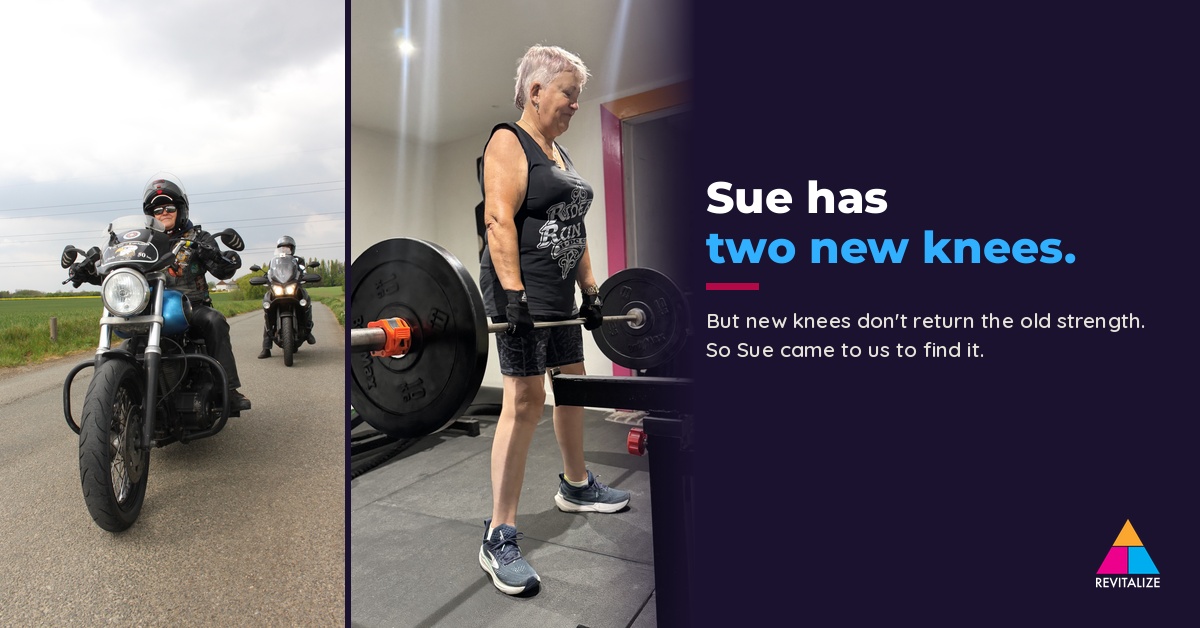
That’s how Sue describes riding her motorbike. For her, it isn’t a hobby. It’s how she sees Europe, meets her friends and spends her summers: riding down to Wales and across the continent, putting her tent up and catching up with people she’s known for years.
She also has two new knees.
Knee replacements can do a lot for pain. What they don’t do on their own is bring back the strength you had before. This is the story of how Sue rebuilt hers, and what strength training after surgery and in later life can give back to you.
Why new knees need new strength
Sue’s motorbike is heavy. “It takes a lot of power to move those,” she says. “It’s a knack, and it does need strength.”
“Even to move it round, you need arm strength, and you need leg strength to hold the bike up as well.”
Strength is something many people lose after a knee replacement without realising. The operation replaces the worn joint, but the thigh muscles that support it are often weak and slow to switch on. Research shows that quadriceps weakness and reduced function commonly persist after knee replacement, and that standard rehab doesn’t always fully address them (Meier et al., 2008).
The good news is that progressive strength training after joint replacement appears safe (Skoffer et al., 2015). In one trial, people who did either high-intensity or lower-intensity rehab after knee replacement were stronger and walked further at 12 months than before their surgery (Bade et al., 2017).
In other words, recovery from a knee replacement doesn’t have to stop when your rehab sessions end.
When strength starts to slip
Sue noticed the change over winter, when she rides less.
“I realised that I was getting weaker and weaker, and I knew I needed the strength to carry on.”
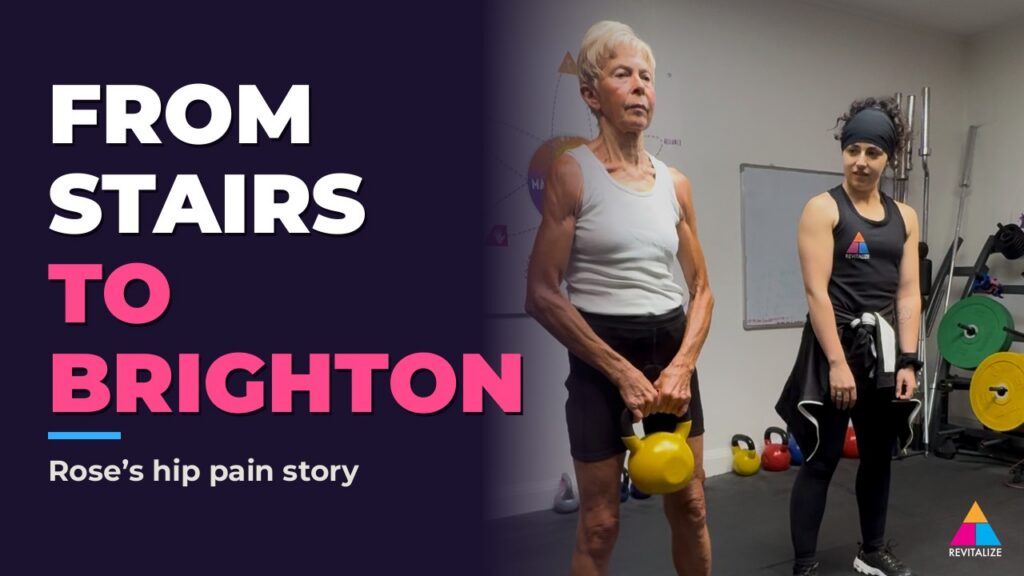
So she started training with Maya, one of our personal trainers, twice a week.
“By doing this twice a week, it’s enabling me to carry on riding for as long as I physically can.”
That’s a modest commitment for a big return. In a large review, as little as 30 to 60 minutes a week of muscle-strengthening activity was linked with a 10 to 20% lower risk of dying early, and of heart disease and cancer (Momma et al., 2022). It’s also never too late to start. In a well-known study, frail nursing home residents with an average age of 90 increased their leg strength by an average of 174% in eight weeks (Fiatarone et al., 1990).
Strength training in later life: what the research says
Fewer falls
Falls are one of the main reasons people lose their independence. A Cochrane review of 59 trials found that exercise reduces the rate of falls in older adults by 23%. Programmes combining balance and functional exercises with strength training probably reduce falls by around a third (Sherrington et al., 2020). The effect was larger when exercise was delivered by a health professional.
A sharper mind
Physical inactivity is one of the 14 risk factors that the Lancet Commission on dementia says we can change (Livingston et al., 2024). Strength training appears to play a part. In the SMART trial, older adults with mild memory and thinking problems who did six months of resistance training improved their overall cognitive function, with benefits still seen 18 months later (Fiatarone Singh et al., 2014).
That doesn’t mean lifting weights prevents dementia. But it is one more reason to keep your muscles working.
Better mood
Sue is honest about what riding does for her. “If I didn’t do that, my husband said, I’ll probably never go out the house, ’cause I don’t work anymore.”
Strength training supports mental health in its own right. A review of 33 trials found that resistance training significantly reduced symptoms of depression, whether or not people got noticeably stronger (Gordon et al., 2018).
Getting up off the floor
For Sue, one of the biggest changes has nothing to do with the bike.
“Even at home, getting out of the chair, I don’t think about it,” she says. “When I go to lie down, I can actually bounce up.”
Before, camping was starting to slip away from her. “I was getting to the stage where that would have stopped me camping, ’cause I couldn’t get down on the floor into my bed.”
Being able to get down to the floor and back up again matters more than it sounds. In a study of more than 2,000 adults aged 51 to 80, each point scored on a simple sit-and-rise test was linked with a 21% better chance of survival over the following six years (Brito et al., 2014). It reflects strength, balance and flexibility working together, and all three can be trained.
What fitness gives you in later life: freedom
When people talk about getting fitter in later life, they often talk about numbers: weight, blood pressure, steps. Sue talks about freedom.
“Pre-COVID, and just after COVID, when I went back to riding, I was an old lady rider. Now I’m an older lady riding.”
She says she feels younger, and her friends are surprised when they find out her age. “I can hold my own against any man that I ride with. And enjoy it.”
That’s what strength gives you as you get older. Not a gym habit for its own sake, but the ability to keep saying yes: to the trip, the campsite, the grandchildren, the garden, the stairs, the life you want.
Why it helps to have a clinic team behind you
Sue first came to us with a shoulder injury, not for personal training.
“What I liked then was, yes, I was treated there, but I was given video exercises to go home and do, not just a sheet of paper,” she says. “It was actually a video that I could copy, and I strengthened my shoulder.”
When she saw that we also offered personal training, she booked a consultation. That was the next step.
Because our personal trainers work in the same building as our osteopaths and physiotherapists, an old injury or a new niggle doesn’t have to stop your training. Your trainer can talk to the clinical team, and your programme can change around you.
“You’ve got a multi-faceted team,” Sue says. “So there will be someone here that will actually help you.”
Before you start: a few safe first steps
-
Check with your surgeon or a clinician first if you’ve had a joint replacement recently. Follow their guidance for the early weeks.
-
Start with what you can do now. Sit-to-stands from a chair, step-ups on the bottom stair and wall press-ups are a good place to begin.
-
Train twice a week. Like Sue, two sessions is enough to make a real difference.
-
Build slowly. The aim is to feel challenged, not sore for days afterwards.
-
Get help if pain changes. New swelling, heat, or pain that’s getting worse is a reason to get checked before carrying on.
The hardest part is walking through the door
Sue’s advice for anyone in her position is simple.
“You have a choice for pain. You might either let it rule you, or you rule it.”
And her last word: “The most difficult thing about everything is always walking through the door.”
If you’ve had a knee replacement, or you’ve noticed your strength slipping, we’d like to help you take that first step. Book a free personal training consultation and we’ll start with what matters to you: what you want to keep doing, and what’s getting in the way.
Sue’s story is her own experience. Everyone’s recovery is different, and results vary.
About Revitalize Personal Training
Revitalize Clinic in Gravesend offers private, one-to-one personal training alongside osteopathy, physiotherapy and sports therapy. Our trainers specialise in strength training for adults returning to exercise, including after surgery and in later life.
References
-
Meier W, Mizner RL, Marcus RL, et al. Total knee arthroplasty: muscle impairments, functional limitations, and recommended rehabilitation approaches. Journal of Orthopaedic and Sports Physical Therapy. 2008. https://pubmed.ncbi.nlm.nih.gov/18448878/
-
Skoffer B, Dalgas U, Mechlenburg I. Progressive resistance training before and after total hip and knee arthroplasty: a systematic review. Clinical Rehabilitation. 2015. https://pubmed.ncbi.nlm.nih.gov/24994766/
-
Bade MJ, Struessel T, Dayton M, et al. Early high-intensity versus low-intensity rehabilitation after total knee arthroplasty: a randomized controlled trial. Arthritis Care and Research. 2017. https://pubmed.ncbi.nlm.nih.gov/27813347/
-
Momma H, Kawakami R, Honda T, Sawada SS. Muscle-strengthening activities are associated with lower risk and mortality in major non-communicable diseases. British Journal of Sports Medicine. 2022. https://pubmed.ncbi.nlm.nih.gov/35228201/
-
Fiatarone MA, Marks EC, Ryan ND, et al. High-intensity strength training in nonagenarians. JAMA. 1990. https://pubmed.ncbi.nlm.nih.gov/2342214/
-
Sherrington C, Fairhall N, Wallbank G, et al. Exercise for preventing falls in older people living in the community: an abridged Cochrane systematic review. British Journal of Sports Medicine. 2020. https://pubmed.ncbi.nlm.nih.gov/31792067/
-
Livingston G, Huntley J, Liu KY, et al. Dementia prevention, intervention, and care: 2024 report of the Lancet standing Commission. The Lancet. 2024. https://pubmed.ncbi.nlm.nih.gov/39096926/
-
Fiatarone Singh MA, Gates N, Saigal N, et al. The Study of Mental and Resistance Training (SMART) study: resistance training and/or cognitive training in mild cognitive impairment. Journal of the American Medical Directors Association. 2014. https://pubmed.ncbi.nlm.nih.gov/25444575/
-
Gordon BR, McDowell CP, Hallgren M, et al. Association of efficacy of resistance exercise training with depressive symptoms. JAMA Psychiatry. 2018. https://pubmed.ncbi.nlm.nih.gov/29800984/
-
Brito LB, Ricardo DR, Araújo DS, et al. Ability to sit and rise from the floor as a predictor of all-cause mortality. European Journal of Preventive Cardiology. 2014. https://pubmed.ncbi.nlm.nih.gov/23242910/
Meet the author
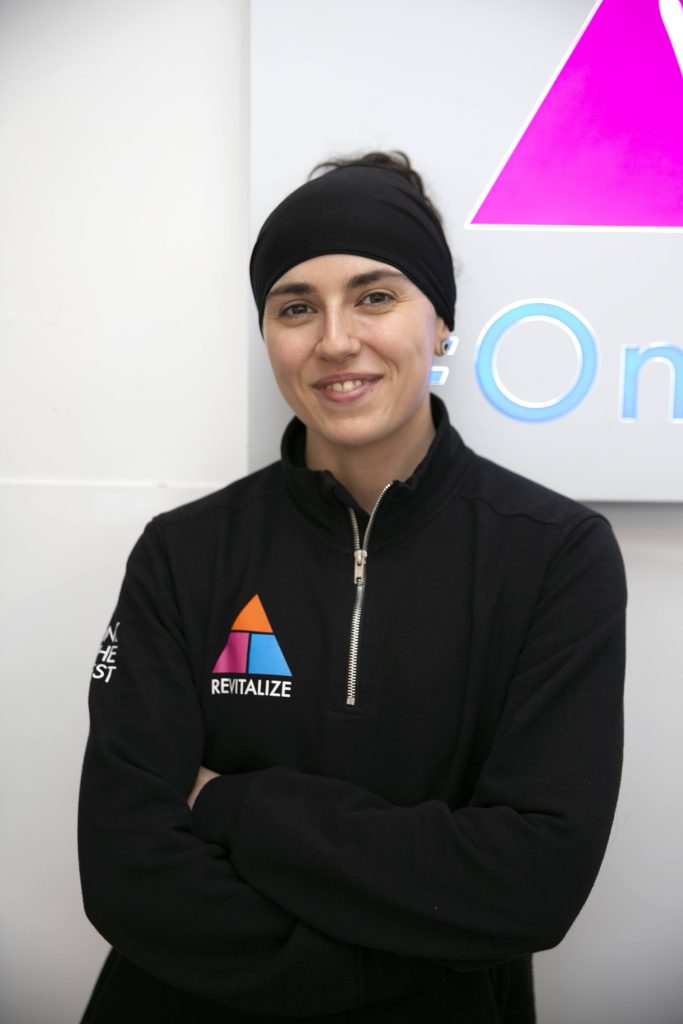
Maya Goodrum (Lv. 3 Dip)
Personal Trainer
Since qualifying as a group exercise to music instructor in 2013, Maya has further qualified and taught in many different disciplines, including Spin, Kettlebells, HIIT and Hydropower, just to name a few. Maya also has extensive experience working with special populations, the elderly, injured, and over weight.
However, Maya hasn’t always had an interest in health and fitness. Maya grew up with out a single drive to do anything active, a couch potato with a gaming habit. Maya soon found that she didn’t like the way her physical and mental health was headed. As a person who suffers with social anxiety, Home work outs were her saving grace, and to this day, she still credits them to be what got her in to shape. Inspired, Maya decided that she wanted to help other people the way fitness has helped her. Maya acclaims health and fitness to have turned her life around.
Since teaching regularly, Maya has gained herself a reputation, as a tough instructor with a gentle touch. As a PT, she uses her comprehensive knowledge of home based workouts and functional fitness to build programmes that are flexible and transferable to any environment.