By loading this video, you agree to the privacy policy of Youtube.
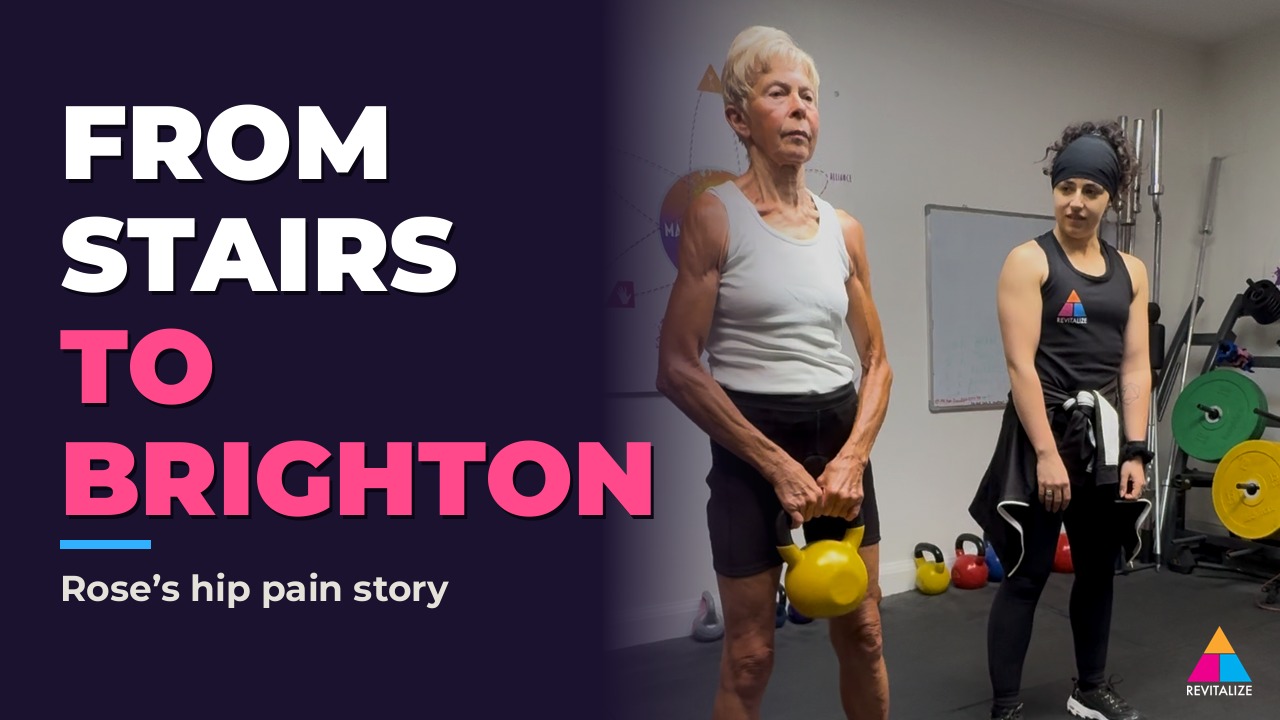
In January, Rose was climbing her stairs on her hands.
“I was putting my hands on the steps and moving my feet up and down actually with my hands,” she told us. “I couldn’t actually balance on the steps and walk up.”
Rose isn’t someone who stops easily. She has been involved in PE and exercise all her life, and she had already signed up for her 26th London to Brighton bike ride. Yet her left hip had become so tight and so weak that walking felt as though her knee might give way.
A few months later, she rode to Brighton and got up all the hills without stopping.
This article explains what happened in between. It isn’t a promise that everyone’s hip pain will follow the same path. It’s an example of how we approach hip pain treatment here in Gravesend: a thorough diagnosis first, then hands-on treatment and strength training, built around what matters to you.
Is my hip pain arthritis?
It might be, but it often isn’t, and that’s why a proper assessment comes first.
Hip pain can come from the hip joint itself, as with osteoarthritis. It can also come from the tendons and muscles around the outside of the hip, from the lower back, or from an irritated nerve. These problems can feel similar but need different plans.
For people aged 45 or over, NICE says osteoarthritis can usually be diagnosed without a scan when there is activity-related joint pain and morning stiffness that lasts no longer than 30 minutes (NICE NG226). Scans aren’t routinely needed unless something doesn’t fit the usual pattern.
Rose had no fall and no injury. Her biggest worry was that something serious was going on. “My concerns were that I had damaged a nerve somewhere,” she said. “It felt as though my brain wasn’t actually functioning with my body.”
That fear is common, and it matters. If you don’t know what’s wrong, it’s hard to commit to exercise, because every twinge feels like damage.
Why diagnosis comes before strength training
Strength training is one of the best things you can do for a painful hip. But starting it without a clear diagnosis is a bit like setting off on a long ride without checking the bike.
In my experience, the people who stick with exercise are the ones who know why they’re doing it, and know which sensations are safe. When we assess a hip, I’m looking at:
-
Your story. When it started, what makes it better or worse, and what you’re worried about.
-
The warning signs. Anything that needs your GP or a scan first.
-
The hip, the back and the nerves. So we’re sure where the pain is really coming from.
-
How you move and how strong you are. Stairs, standing on one leg, getting up from a chair, and whatever you need to get back to doing.
That last point is where treatment becomes personal. Rose didn’t come in wanting “less hip pain”. She wanted to cycle, run and walk like herself again.
A clear diagnosis also helps you understand pain during exercise. NICE advises that joint pain may increase a little when you start exercising, and that regular, consistent exercise is still good for your joints (NICE NG226). Knowing that in advance, from someone who has examined you, means you can train with confidence instead of fear.
What happens in the treatment room?
Rose started with hands-on treatment. “It was very interesting that you managed to loosen things up within my leg through the manipulation,” she said. “You were obviously feeling what was wrong.”
Hands-on treatment has a place in hip pain. In one trial of people with hip osteoarthritis, a manual therapy programme gave better short-term results for pain, stiffness and hip function than an exercise programme (Hoeksma et al., 2004). A larger trial found that manual therapy and exercise each helped compared with usual care, but that combining them didn’t add extra benefit (Abbott et al., 2013).
NICE recommends that hands-on treatment for hip or knee osteoarthritis is only used alongside exercise, not on its own (NICE NG226).
So we use hands-on treatment for what it does well: easing pain and stiffness enough for you to move. When you’re as sore as Rose was, it can be hard to do much at all. That’s when we take more of the load for a while. As you get stronger, we hand the work back to you.
If you’d like to know more, see our page on seeing an osteopath for hip pain.
Why strength training matters for hip pain
Once Rose’s hip was moving more freely, I suggested she work with Maya, one of our personal trainers.
“And she’s just fantastic, the exercises she put me through,” Rose said. “Gentle to start with, then getting harder and harder, but very slowly.”
That slow build is important. A Cochrane review of ten trials found high-quality evidence that land-based exercise reduces pain and improves physical function in people with hip osteoarthritis (Fransen et al., 2014). NICE recommends therapeutic exercise, such as local muscle strengthening and general fitness, for everyone with osteoarthritis, and suggests supervised sessions (NICE NG226).
Supervision made a difference for Rose too. “Someone watching you while you’re doing that can tell you exactly which way your body is moving,” she said, “and saying to you, this is how you should feel.” For someone who had exercised all her life, she described it as “a real eye opener”.
Within a few weeks, she could run again.
Why a team approach helps
Rose’s care moved from one clinician to another without her having to start again. The osteopath and the personal trainer worked from the same assessment and towards the same goal.
That matters most when pain has gone on for a while. For long-term low back pain, a Cochrane review found that programmes combining physical treatment with support for the psychological and social side of pain reduced pain and disability more than usual care (Kamper et al., 2015). That review looked at back pain, not hips, but the principle carries over: pain affects how you move, sleep, feel and live, so the plan should cover more than one thing.
Why your values should shape your plan
The best rehab plan is the one you’ll actually follow. Research on exercise motivation suggests that people whose reasons come from their own values and enjoyment are the most likely to keep going long term (Teixeira et al., 2012).
For Rose, those values were clear: staying fit, staying active, and getting back on her bike. The London to Brighton ride gave her a reason to keep going on the days it felt hard.
“I had already put my name down to do it, but there was a case of, right, I’ll just sit back,” she said. “And I thought, no, this exercise is really working. And I continued with it.”
So one of the first things we ask isn’t “where does it hurt?” It’s “what do you want to get back to?”
What you can try at home
-
Keep moving, gently. Rest for a day or two if it’s very sore, but long periods of rest tend to make a stiff hip stiffer.
-
Notice your patterns. Write down what makes it worse (stairs, getting out of the car, lying on that side) and what eases it. It will help your assessment.
-
Try a sit-to-stand. Stand up from a firm chair slowly, without using your hands if you can, five to ten times. If that’s too hard, use a higher seat.
-
Don’t push through sharp pain. Mild discomfort while exercising can be normal. Sharp or worsening pain is a reason to get it checked.
When should I see a GP about hip pain?
The NHS advises seeing a GP if hip pain is stopping your normal activities or sleep, keeps getting worse or coming back, or hasn’t improved after two weeks.
Ask for an urgent GP appointment or call NHS 111 if you have sudden severe hip pain without an injury, a hot or swollen hip, or hip pain with a high temperature. Call 999 or go to A&E if you can’t put weight on your leg after a fall or injury.
We work alongside GPs and the NHS, and we’ll refer you on if anything in your assessment needs medical investigation.
The short version
-
Hip pain isn’t always arthritis. A thorough diagnosis tells you what’s going on, and which sensations are safe to train through.
-
Hands-on treatment can ease pain and stiffness enough to get you moving. Strength training builds a hip that lasts.
-
A plan built around what matters to you is one you’re more likely to stick to.
“Had it been February time, I would never have been able to do it,” Rose said of her ride. Asked where she’d send a friend in the same position, she didn’t hesitate.
If your hip is stopping you doing what you love, book an assessment and we’ll start with your story. If you’re already free of pain and want to build strength safely, see our personal training in Gravesend.
Rose’s story is her own experience. Everyone’s hip pain is different, and results vary.
References
-
National Institute for Health and Care Excellence. Osteoarthritis in over 16s: diagnosis and management (NG226). 2022. https://www.nice.org.uk/guidance/ng226/chapter/Recommendations
-
Fransen M, McConnell S, Hernandez-Molina G, Reichenbach S. Exercise for osteoarthritis of the hip. Cochrane Database of Systematic Reviews. 2014. https://pubmed.ncbi.nlm.nih.gov/24756895/
-
Hoeksma HL, Dekker J, Ronday HK, et al. Comparison of manual therapy and exercise therapy in osteoarthritis of the hip: a randomized clinical trial. Arthritis and Rheumatism. 2004. https://pubmed.ncbi.nlm.nih.gov/15478147/
-
Abbott JH, Robertson MC, Chapple C, et al. Manual therapy, exercise therapy, or both, in addition to usual care, for osteoarthritis of the hip or knee: a randomized controlled trial. 1: clinical effectiveness. Osteoarthritis and Cartilage. 2013. https://pubmed.ncbi.nlm.nih.gov/23313532/
-
Kamper SJ, Apeldoorn AT, Chiarotto A, et al. Multidisciplinary biopsychosocial rehabilitation for chronic low back pain: Cochrane systematic review and meta-analysis. BMJ. 2015. https://pubmed.ncbi.nlm.nih.gov/25694111/
-
Teixeira PJ, Carraça EV, Markland D, Silva MN, Ryan RM. Exercise, physical activity, and self-determination theory: a systematic review. International Journal of Behavioral Nutrition and Physical Activity. 2012. https://pubmed.ncbi.nlm.nih.gov/22726453/
-
NHS. Hip pain in adults. https://www.nhs.uk/conditions/hip-pain/

Elliott is registered with AXA, Vitality, WPA, Cigna, and Aviva.