By Katie Avery, Paediatric Osteopath, Revitalize Clinic, Gravesend
A mum came to see me recently with her little boy. He had a tongue tie, and for weeks feeding had been a battle. She had been getting support while she was breastfeeding, but when she made the decision to move to bottle feeding, that support came to an end.
The problems didn’t end with it. He still couldn’t hold a seal on the teat. Milk spilled everywhere. He gulped air because his tongue couldn’t control the flow, then he was windy and miserable afterwards. Feeds had become something they were both dreading, when they should have been a time to be close.
Whether your baby is breast fed, bottle fed or both, feeding problems matter. That’s why every baby who comes to see me as a baby osteopath in Gravesend has their mouth checked as a standard part of their first appointment.
(Details changed to protect the family’s privacy, shared with their permission.)
What is tongue tie?
Tongue tie is where the piece of skin connecting the tongue to the floor of the mouth is shorter or tighter than usual. It doesn’t always cause problems, but it can make it hard for the tongue to lift, move side to side or stick out (NHS).
It’s common. In England’s most recent Infant Feeding Survey, around 1 in 6 mothers said their baby had been diagnosed with a tongue tie, and 75% of those said it had caused feeding problems (Infant Feeding Survey 2024).
Signs your baby might have a tongue tie
The NHS lists these signs (NHS):
-
difficulty latching, or staying on the breast or teat
-
very long or very frequent feeds
-
dribbling a lot during feeds
-
coughing, choking or clicking while feeding
-
only taking small amounts at a time
-
slow weight gain
If you’re breastfeeding, you might also have sore nipples or painful, swollen breasts.
Is it always the tongue tie?
Not always, and this is the part I most want parents to know.
A 2025 review of 12 studies and over 8,500 babies found that around 7 in 10 babies with breastfeeding difficulties did not have a tongue tie. The authors advised clinicians to look carefully for other causes before referring for surgery (Midwifery, 2025).
In my experience, it’s rarely just the tongue. Feeding uses the whole body: the jaw, the neck, the way your baby holds themselves, and the position you’re both in. If any part of that is uncomfortable, feeding gets harder.
What I look for
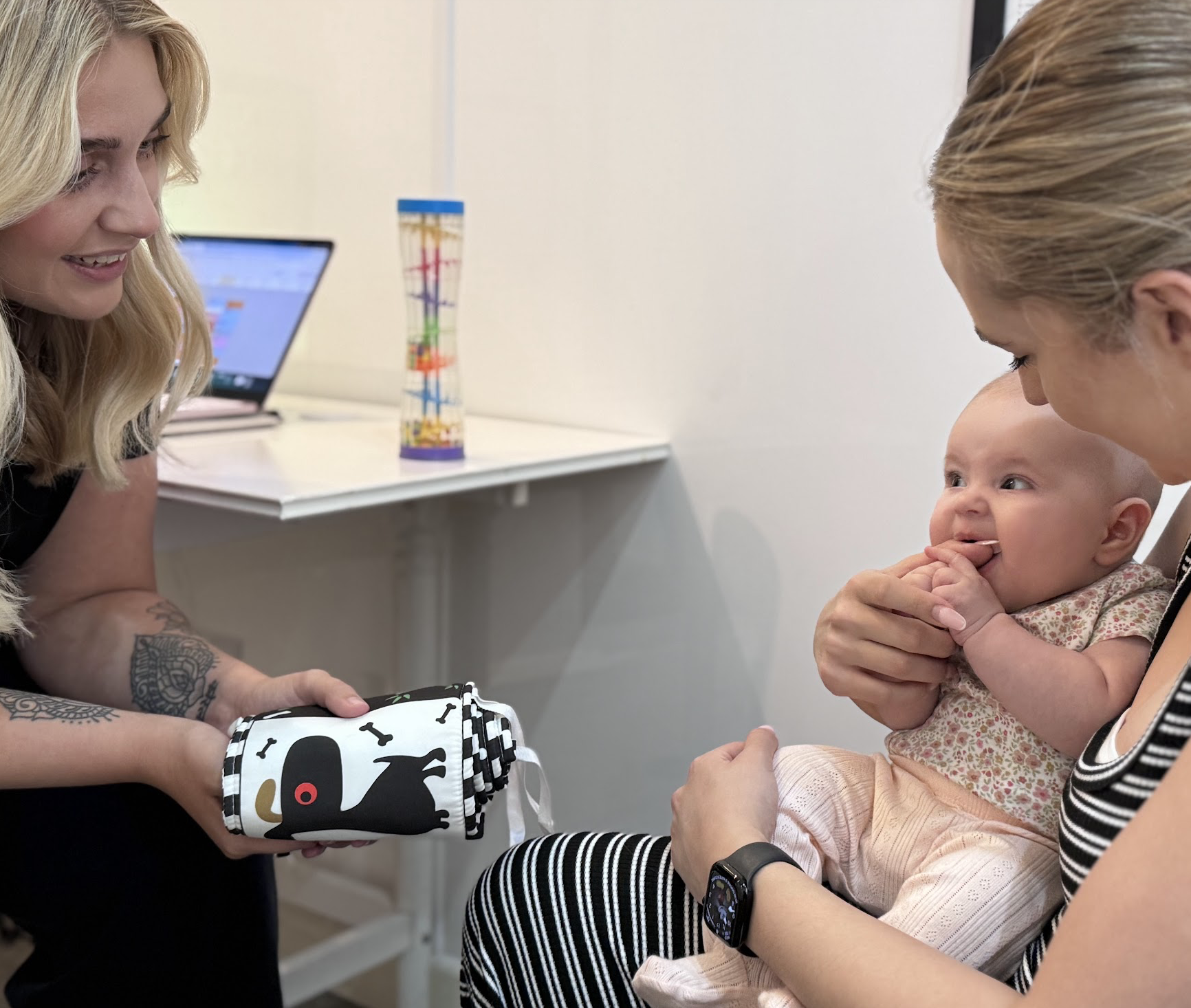
When your baby cries, I’m watching their tongue. Does it lift? Does it cup? Does it stay flat? Is the tip heart-shaped?
Then, with a gloved finger, I gently check:
-
how freely the tongue moves
-
the shape and height of the roof of the mouth
-
the strength and pattern of their suck
Where possible, I’ll watch a breast or bottle feed. This shows me how wide the jaw opens, how easily your baby turns their head to each side, and how comfortable they are in the feeding position.
I’ll explain everything I find as I find it, so you leave understanding your baby better than when you arrived.
Can osteopathy help with tongue tie?
Let me be clear about what osteopathy can and can’t do.
Osteopathy can’t release a tongue tie. If the tie itself is restricting your baby’s feeding, the treatment is a quick procedure called tongue-tie division (frenulotomy). If I think your baby needs one, I’ll refer you to a trusted, experienced practitioner.
What I can do is look at the whole picture alongside your midwife, health visitor or lactation consultant. That means gentle, hands-on care to help your baby feel comfortable through their neck, jaw and body. It also means practical advice on feeding positions, and support for you too, because holding the same position many times a day takes its toll.
What does the research say? It’s still early. A 2026 review of 35 studies found preliminary evidence that osteopathic treatment may support feeding, and called for more research (Journal of Human Lactation, 2026). A small 2025 trial of 40 newborns with feeding difficulties found a moderate improvement in feeding scores after two osteopathic treatments, with no side effects reported (Journal of Osteopathic Medicine, 2025). Some NHS trusts also mention that an osteopath can sometimes help with muscle tension and feeding (University Hospitals Dorset).
I’d rather tell you that honestly than overpromise.
Questions to ask your midwife or health visitor
-
Has my baby’s tongue movement been checked, not just how the tongue looks?
-
Could anything else be making feeding hard?
-
Can someone watch a full feed?
-
If my baby needs a tongue-tie division, how long is the wait?
-
What support is there if I’m bottle feeding?
The key points
-
Tongue tie is common, but it isn’t always the reason feeding is hard.
-
Feeding involves the whole body, yours and your baby’s.
-
A good assessment looks at the tongue, the jaw, the neck, posture and the feed itself.
Osteopath for tongue tie in Gravesend, Kent
If you’re looking for an osteopath for tongue tie in Gravesend and feeding is hard work, I’d be glad to help. Find out more about our baby osteopath service in Gravesend, at Revitalize Clinic, 168 Windmill Street, Gravesend. Families come from across Kent, including Northfleet, Dartford, Swanscombe and Meopham.
Book a free discovery call. No commitment, just a proper conversation about what’s going on for you and your baby.
References
-
NHS. Tongue-tie. https://www.nhs.uk/conditions/tongue-tie/
-
Department of Health and Social Care. Infant Feeding Survey 2024: full report. https://www.gov.uk/government/statistics/infant-feeding-survey-in-england-2024/infant-feeding-survey-2024-full-report
-
Midwifery, 2025;149:104564. Systematic review and meta-analysis of tongue tie among infants with breastfeeding difficulties. https://pubmed.ncbi.nlm.nih.gov/40818366/
-
Journal of Human Lactation, 2026. Scoping review of osteopathic treatment in breastfeeding parents and infants. https://pubmed.ncbi.nlm.nih.gov/42001426/
-
Journal of Osteopathic Medicine, 2025. Randomised controlled pilot study of osteopathic treatment alongside lactation support in newborns. https://pubmed.ncbi.nlm.nih.gov/41351353/
-
University Hospitals Dorset. Tongue-tie information leaflet. https://www.uhd.nhs.uk/uploads/about/docs/our_publications/patient_information_leaflets/maternity/tongue-tie-information.pdf
About the Author

Katie is registered with Vitality and WPA.